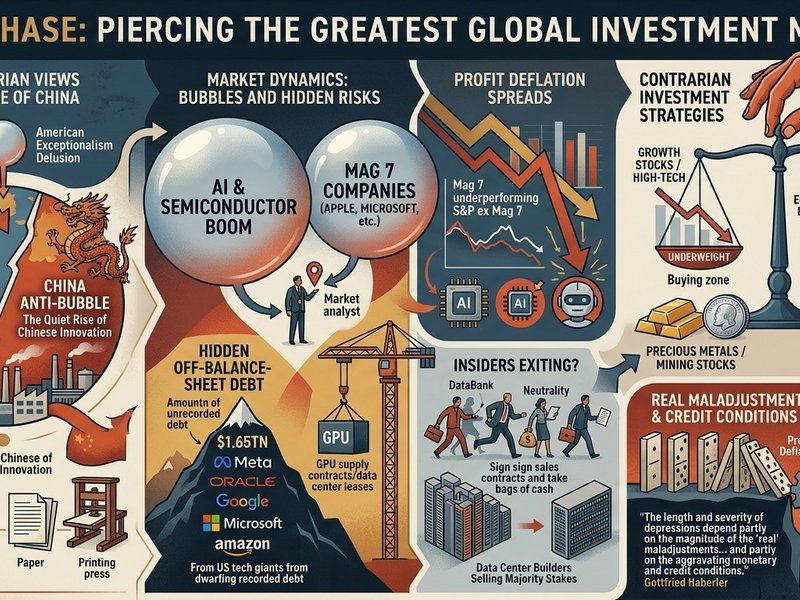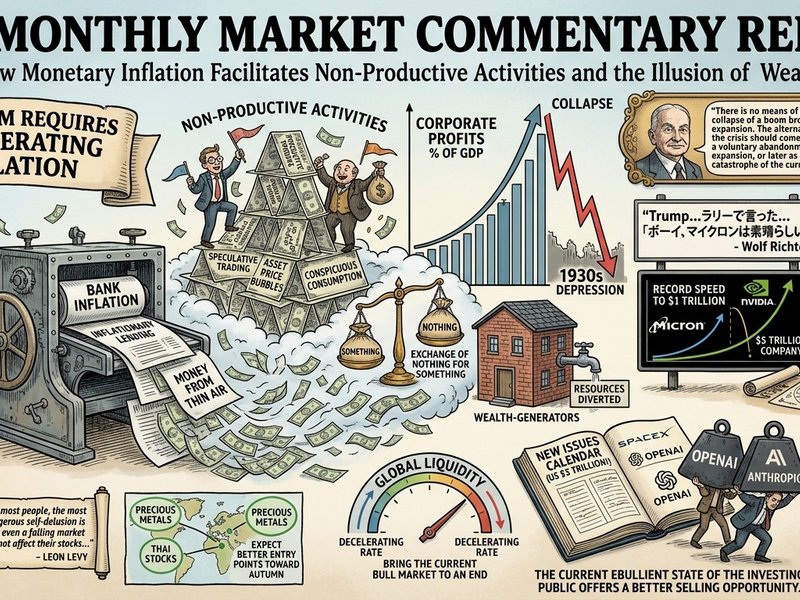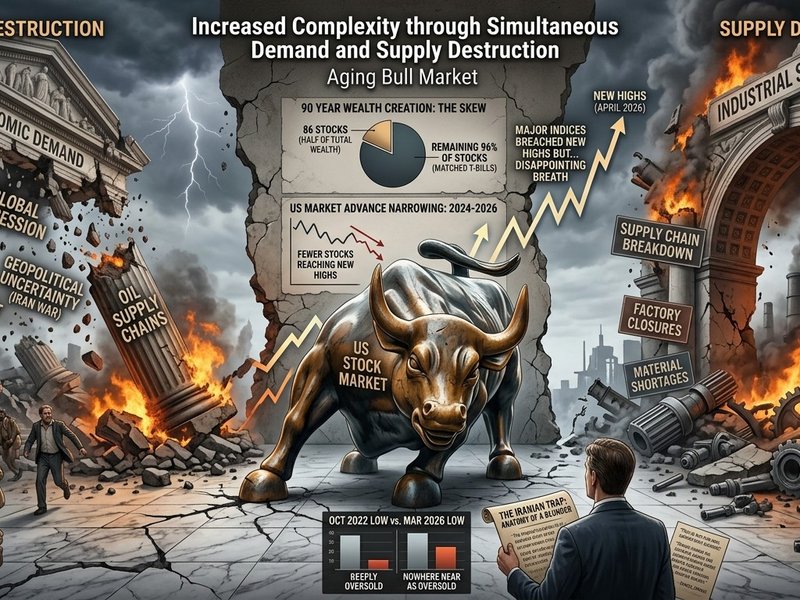
Starting with the July report entitled The Greatest Global Investment Mania in modern History and the August report discussing Characteristics of the first Phase of the Piercing of the greatest global Investment Mania, I turned increasingly bearish about stock prices. Among the prime characteristics of an investment mania, I however, omitted one major issue. In earlier newsletters I had explained to my readers that the movement of financial stocks was in my analysis of stock market cycles, of great importance. Strength in financial stocks was in my opinion always a condition for an upward trend in stock prices whereas weakness was to be considered very negatively. In 2020/2021, financials were depressed, neglected and avoided by the investment community. More recently, financial had become extremely popular as value stocks after having traced out powerful upward move, which were largely driven by unprecedented monetary inflation post COVID. The recent breakdown of financials, does concern me.
The super-bulls will rightly ask: “Marc, why do you believe that financial have made a major top? After all, following the 2020 low, we had numerous corrections, most notably during the advent of the Ukraine war in February 2022 and the Trump Tariff tantrum of April 2025, which nonetheless subsequently led to new highs. Why would it not likely be similar this time: just a correction leading to a new high?
The BLS grossly understates the true increases in the cost of living, I believe that real wages (inflation-adjusted) have been negative for ages, but admittedly more so recently. In other words, currently it is likely that expansionary monetary policies would be ineffective at stimulating economic activity because price increases would exceed income gains for the typical household. Furthermore, expansionary monetary policies seem to be ineffective at lowering the interest rate on long-term Treasuries as we recently saw.
Core capital goods orders are a sign that manufacturing is getting a massive boost from the AI infrastructure investment boom.
There is no doubt that rapid price increases driven partly by the ongoingcapital spending boom are reducing liquidity in the system and will likely lead to even higher interest rates.
JP Morgan just published a graph depicting the debt issuance of the hyperscaler + NVIDIA as a percentage of Treasury bond issuance, which shows the gargantuan appetite for capital in the AI and related sectors. Needless to say, just like every capital spending boom, excess capacities will be built in AI related sectors (e.g. datacenters, semiconductors, etc.), and a colossal bust will follow the boom.
I doubt that Wall Steet economists and strategists understand the powerful positive impact monetary inflation and a simultaneous capital spending boom have on corporate profitability during an upswing. [Once the capital spending boom turns down, corporate profits are likely to tumble and surprise investors by the severity of the contraction.]
Naturally, I am constantly thinking about what I should buy with the cashflow from my existing investments, and the liquidation of some of the banks and insurance companies that I hold. As explained in earlier report, I have a preference for defensive and value stocks while avoiding high flying popular tech stocks.
My portfolios contain mostly value and emerging market stocks and I am a believer that these value sectors are relatively attractive. My more financially enlightened friends tell me just how cheap oil & gas stocks and mining companies are and since I own both oil & gas producers and distributors, and mining companies as well, I tend to agree with this view.
However, there are many good reasons why oil companies and miners are selling at low valuations. My main concerns centers around the litigation risk for oil & gas companies and expropriation risk in general for resource companies – this especially under the increasingly authoritarian Trump administration and goes without saying, that the democrats are not going to be any better, if at all worse.
If we look at the Percentage of S&P 500 Stocks above their 200-Day Moving Average, fewer and fewer stocks trade above the 200-day moving average. Furthermore, I find it disturbing that so close to new all-time highs for the major Indices, 12-month new lows are now regularly exceeding12-month new highs. Finally, the breakdown of so many important financial stocks (discussed above) is from my perspective an extremely negative omen for the entire market.
My readers should in this respect also ask themselves the following. I am convinced that the colossal asset inflation which we experienced for most of our lifetime will give way at some point to a widespread asset price contraction brought about by debt deflation (massive defaults). It should be clear to everyone that there will be a time when the enthusiasm the public and foreign investors are showing with their stock and bond purchases will give way to tsunami like selling, which will depress stocks and the dollar, and possibly bonds even more. It is my conviction that once domestic and global fund flows reverse the negative impact on asset prices would be of cataclysmic dimensions. For this reason, I am reluctant to enthusiastically endorse the purchase of any asset at this point and I am reasonably happy to accumulate cash and bonds whose returns have been more recently, the worst in history.
With kind regards
Yours sincerely
Marc Faber
Ready to get started?