My friend, the highly respected, “pure” and dogmatic Austrian Economics protagonist, Frank Shostak recently published for the Mises Institute an article with the title, Is Deflation Bad for the Economy?
The economist Joseph Schumpeter had postulated that, “The capitalist engine is first and last an engine of mass production which unavoidably also means production for the masses. It is the cheap cloth, the cheap cotton and rayon fabric, boots, motorcars and so on that are the typical achievements of capitalist production, and not as a rule, improvements that would mean much to the rich man. Queen Elizabeth owned silk stockings. The capitalist achievement does not typically consist in providing more silk stockings for queens but in bringing them within reach of factory girls.”
Shostak writes that, “In contrast, when inflationary lending originates out of ‘thin air,’ and the borrowed money is returned on the maturity date to the bank, this results in a withdrawal of money from the economy (i.e., to the decline in the money supply). The reason is because, in this case, we never had a saver/lender, since this lending was generated by bank inflation. Such lending is a catalyst for an exchange of nothing for something. This provides a platform for various non-productive activities that—prior to the generation of inflationary lending—would not have emerged……
These non-productive activities cannot stand on their own. These activities require continual inflationary increases in money supply that divert these activities’ resources from wealth-generators.”
This is the problem: the monetary inflation has to expand at an accelerating rate in order to sustain the boom but as von Mises observed, “There is no means of avoiding the final collapse of a boom brought about by credit expansion. The alternative is only whether the crisis should come sooner as a result of a voluntary abandonment of further credit expansion, or later as a final and total catastrophe of the currency system involved.”
I need to add here that aside from the public, Wall Street adores money printing because rising asset prices, and especially rising stock prices boost their income and wealth enormously. Therefore, the first observation I would like to make is that: Monetary inflation seems to be favorable for corporate profits. However, when monetary growth slows down as in 1980s, or money supply contracts as in the 1930s, corporate profits as a percentage of GDP slow down or contract as in the 1930s depression.
Regarding the stock market, Wolf Richter (www.wolfstreet.com), noted: “Trump was helping along the way. On Friday (May 22, 2026), he said at a rally, ‘Boy, Micron is great.’
In terms of market cap, Micron’s path to a $1 trillion stock from a $500 billion stock broke all records: only 48 trading days to reel in the second $500 billion after the stock hit $500 billion in market cap for the first time on March 17……In terms of speed from $500 billion to $1 trillion, that 48 trading days was by far a record. Nvidia, the poster boy for this sort of stuff, took 490 trading days to get there. Nvidia is now a $5 trillion company….. Now there are 12 publicly traded US companies valued at over $1 trillion, including Micron.”
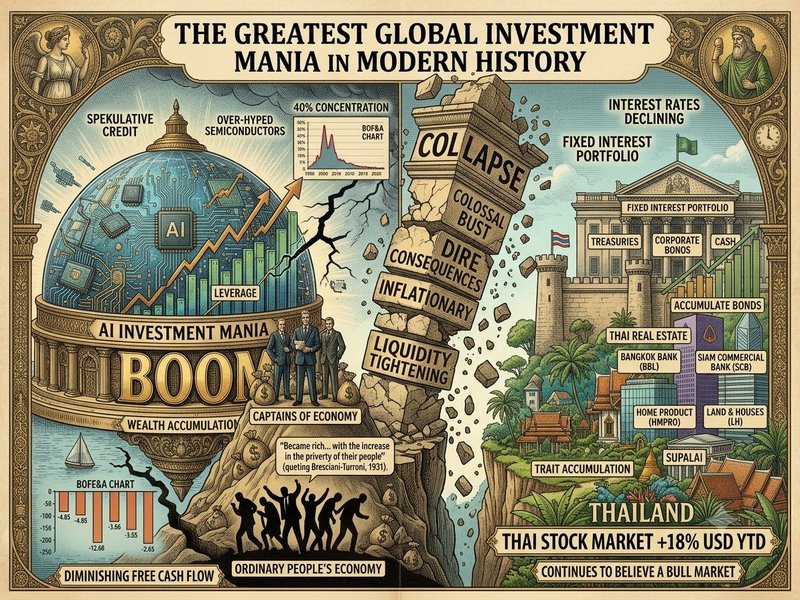
MF: About how far this Mania will go, let me remind my readers of the words of Isaac Newton after he lost a ton of money following the bursting of the South Sea bubble: Newton: “I can calculate the motion of heavenly bodies, but not the madness of people.”
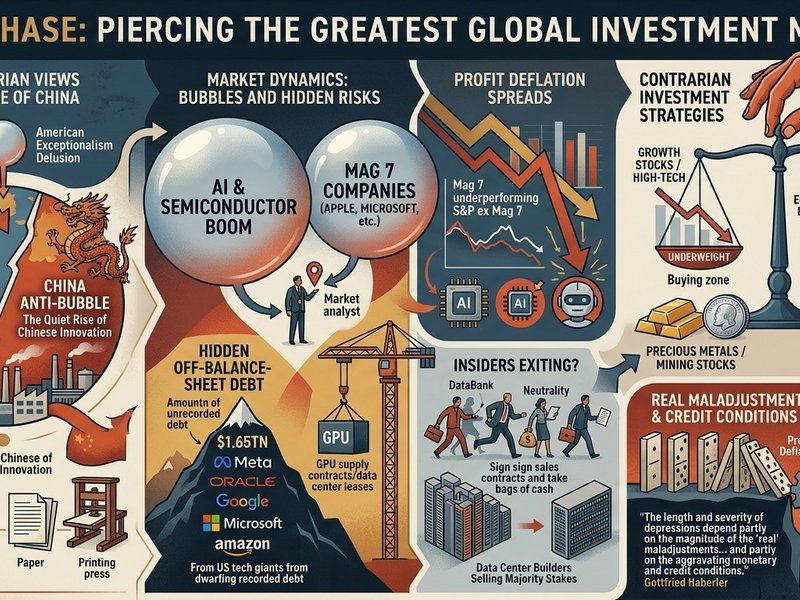
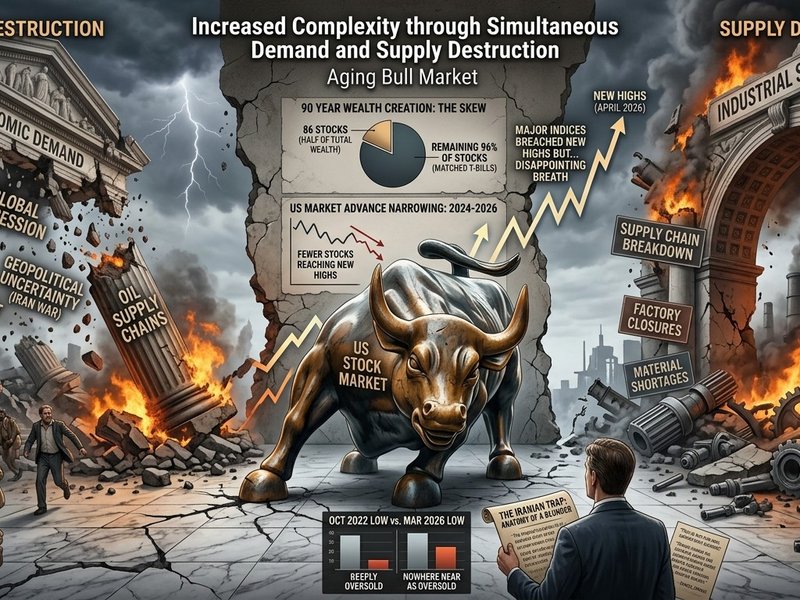
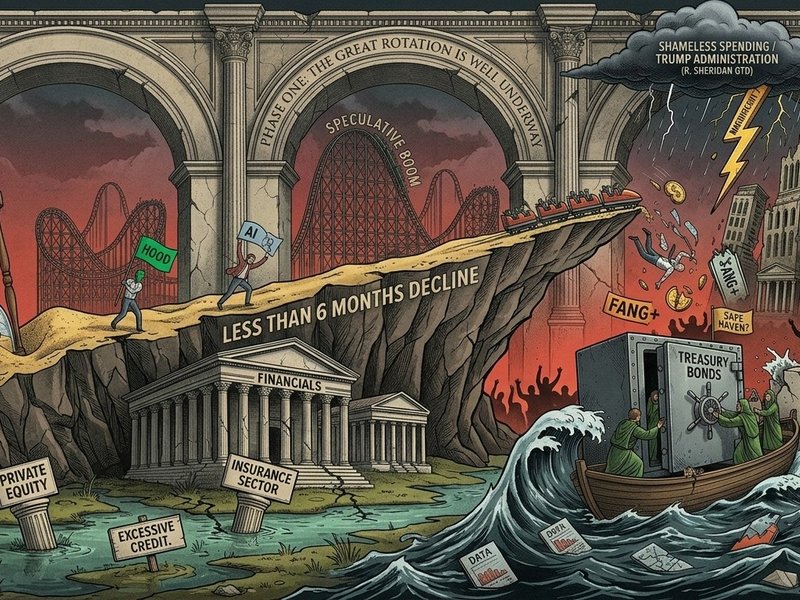
My view is that, as I write this comment, global liquidity has begun to grow at a decelerating rate, which is sufficient to bring the current bull market in assets to an end. Massive issuance of Treasury bonds and a heavy new issue calendar for equities including SpaceX and OpenAI, while Anthropic is reportedly evaluating a debut of its own. Assuming that all three issues proceed, public investors could be asked to absorb nearly $3 trillion (yes US dollar three trillion) of new market value in a rather short period of time. Furthermore, liquidity has tightened for many investors because of the decline in real estate values, crypto currencies, private equity and private credit (a disaster waiting to happen), and a large number of stocks that are no longer rising (see last month’s report). Concerning tighter liquidity I must point out that I regard the non-confirmation of the bull market by financial stocks as a negative omen. (year-to-date, the S&P 500 is up 10% and financial stocks are down 5%).
In sum, I believe the current ebullient state of the investing public offers a better selling opportunity than a buying opportunity with a few exceptions, I do concede. However, even for these relatively attractive sectors and markets (precious metals and Thai stocks as an example), I expect better entry points to arise toward the autumn.
Lastly, I want to repeat the wise words of the late Leon Levy who opined that, “For most people, the most dangerous self-delusion is that even a falling market will not affect their stocks, which they bought out of a canny understanding of value.”
With kind regards
Yours sincerely
Marc Faber
Ready to get started?