The title of last month’s report was Has a Great Rotation begun?In the context of this proposition several charts caught my attention recently.
Given by how much an entire generation of young people gullibly believed in the merits of cryptocurrencies, I found their recent collapse in prices from the October 6, 2025 high to be rather remarkable.
What is also of peculiar interest is that at current levels, Bitcoin prices are about the same they were at the November 2021 high. In other words, it took approximately 4 years to move from $68,000 to the October 2025 peak at $126,000 but less than 6 months to decline from the high to the current level at $68,000.
We can observe similar patterns about equities. Robinhood (HOOD), became a public company in late July 2021, when the company placed its stock with the public at $38 per share. The shares promptly soared to a high of $85 in early August 2021. However, from the August 4, 2021 top, it was a rapid decline to $10 already by January 2022, just as the S&P500 Index was making a new high. Thereafter, it took until the end of 2023 to build a base from where the stock would soar to a peak of $154 in early October 2025.
Now just 6 months after the peak, the stock is down by 51%, and it is below the August 2021 high. It took the stock between December 2023 and October 2025 (22 months to complete a huge upward move but only 6 months to drop by more than 50%.
Oracle (ORCL) rose from June 2024 to the September 2025 high of $345 (15 month), and less than 6 months to give back the entire advance.
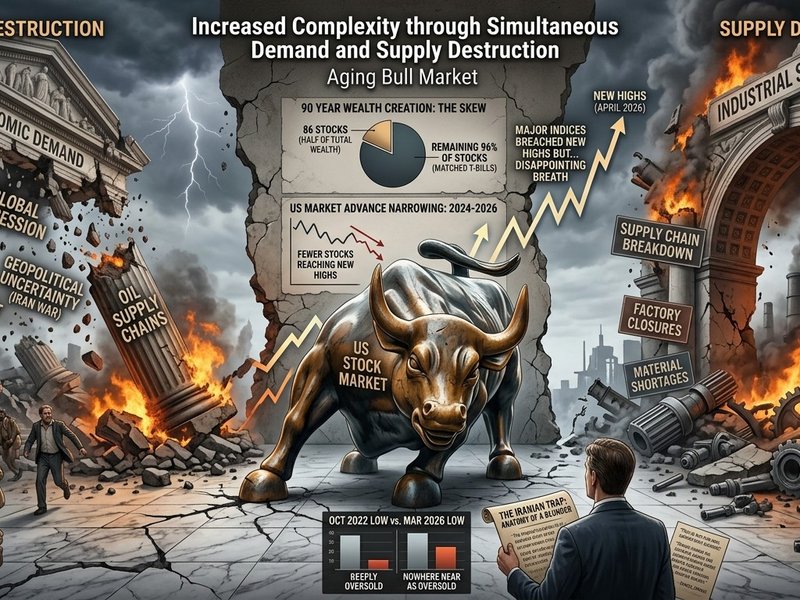
There are three points about the stock performances that I described above which spring to my mind. Recent highly expansionary monetary policies seem to have exacerbated price swings (or as is commonly said), the volatility of assets. [The outbreak of war in the Middle East will also increase volatility.] Secondly, it would appear that price declines occur with more intensity and at a more rapid pace than the preceding price increases. Lastly, if someone showed me the charts of these stocks, I would not believe that the stock market is still close to an all-time high although some serious breaks have occurred among the Magnificent 7 stocks and among the NYFANG+ Index and related stocks.
Furthermore, it appears that financials are breaking down, which is a very negative sign. I should add that financial stocks would seem to have additional significant downside risk.
Every investment mania is accompanied and caused to some extent by excessive credit. Once the object of speculation (nowadays software, AI related, social media, semiconductor, etc. stocks) comes under price pressure, bad loans expand, and usually cause considerable damage to the financial sector including banks, brokers, insurance companies, consumer credit companies, etc. I know some analysts that are ultra bearish about the insurance sector because of its heavy participation in private equity and private credit.
In earlier reports, I mentioned that I was relatively positive about Treasury bonds because I believe that the American consumer is in far worse shape than the government’s statistics would suggest. [Just look at what Diageo, the producer of Johnnie Walker, Smirnoff, Captain Morgan, etc. had to say about the US consumer market.] In fact, I would be extremely bullish about Treasuries except for the Trump administration that will spend money shamelessly because Mr. Trump, based on his history as a businessman, is not a believer in repaying debts – just as Richard Sheridan, the 18th century playwright was not who said, “You know it is not my interest to pay the principal, or my principal to pay the interest.”
The other reason for not being enthusiastically bullish about government bonds is that compared to consumer price inflation, their yield is not particularly high. However, as a believer that we shall shortly experience massive asset price deflation in just about everything (such as we just saw in cryptocurrencies, and in commercial properties in recent years), I find Treasuries to be relatively attractive.
Finally, remember the word of Bob Farrell, former Chief Stock Market Analyst at Merrill Lynch, who opined that, “Change of a long-term trend is usually gradual enough that it is obscured by the noise caused by short-term volatility. By the time secular trends are even acknowledged by the majority they are generally obvious and mature. In the early stages of a new secular paradigm, therefore, most are conditioned to hear only the short-term noise they have been conditioned to respond to by the prior existing condition. Moreover, in a shift of long-term significance, the markets will be adapting to a new set of rules while most market participants will be still playing by the old rules.”
With kind regards
Yours sincerely
Marc Faber
Ready to get started?